
A language model can tell you ninety-seven distinct things Captain William Toney is qualified to teach. Redfish on pressured flats with live bait. Seatrout through the winter-to-spring transition. Tripletail on homemade attractors built from rope and crab buoys. Ninety-seven topics, each tied to a live page, each declared in a format machines read directly.
That same model cannot reliably tell you he is a fourth-generation Homosassa guide. It cannot tell you that his charter business and his instructional videos belong to the same man. It cannot tell you which of the several versions of his name and business scattered across the web is the one to trust.
That gap is the whole problem, and it is not the problem most people assume it is. The instinct is to call it a content problem, or an authority problem, or a case of a good guide who needs more exposure. It is none of those. Toney has more documented authority than most operators in his field will accumulate in a career. The authority is real. The machine just cannot see it as one thing.
Disclosure
I run In The Spread, and Captain Toney is a minority owner of it, so his instructor page there is not a client result. It is a reference for what a complete entity looks like when one operator controls the whole stack. His charter site, which my agency built, is the working example. The open question this piece is actually about is whether that engineered node can outweigh the surfaces neither of us controls.
The authority is not in question
Start with what is already true and already public.
Toney is a fourth-generation guide on the same water his family has fished for four generations. He puts out a weekly fishing report on Channel 16 WYKE, Citrus Today, Fridays at 9:30 in the morning. He writes a weekly column that runs in a regional outlet. His reports and articles have appeared in three Florida newspapers and in Florida Sportsman. He hosts an extensive library of instructional videos. He is a United States Coast Guard licensed and insured captain, a member of the Homosassa Guides Association, and a member of the Florida Outdoor Writers Association. He runs a custom 23-foot Tremblay flats boat built for the shallow water he works.
Weekly television. Weekly print. Weekly column. A national video library. Two professional associations. Four generations on the water. There are charter operators outranking him in AI answers today with a tenth of that record. His problem was never a shortage of authority. It was that the authority was scattered across surfaces that never point at each other.
What the machine actually sees
A person reading about Toney across the web sees one accomplished guide. A machine assembling an answer sees something else: six or seven partial references to slightly different name strings, on different domains, with nothing connecting them.
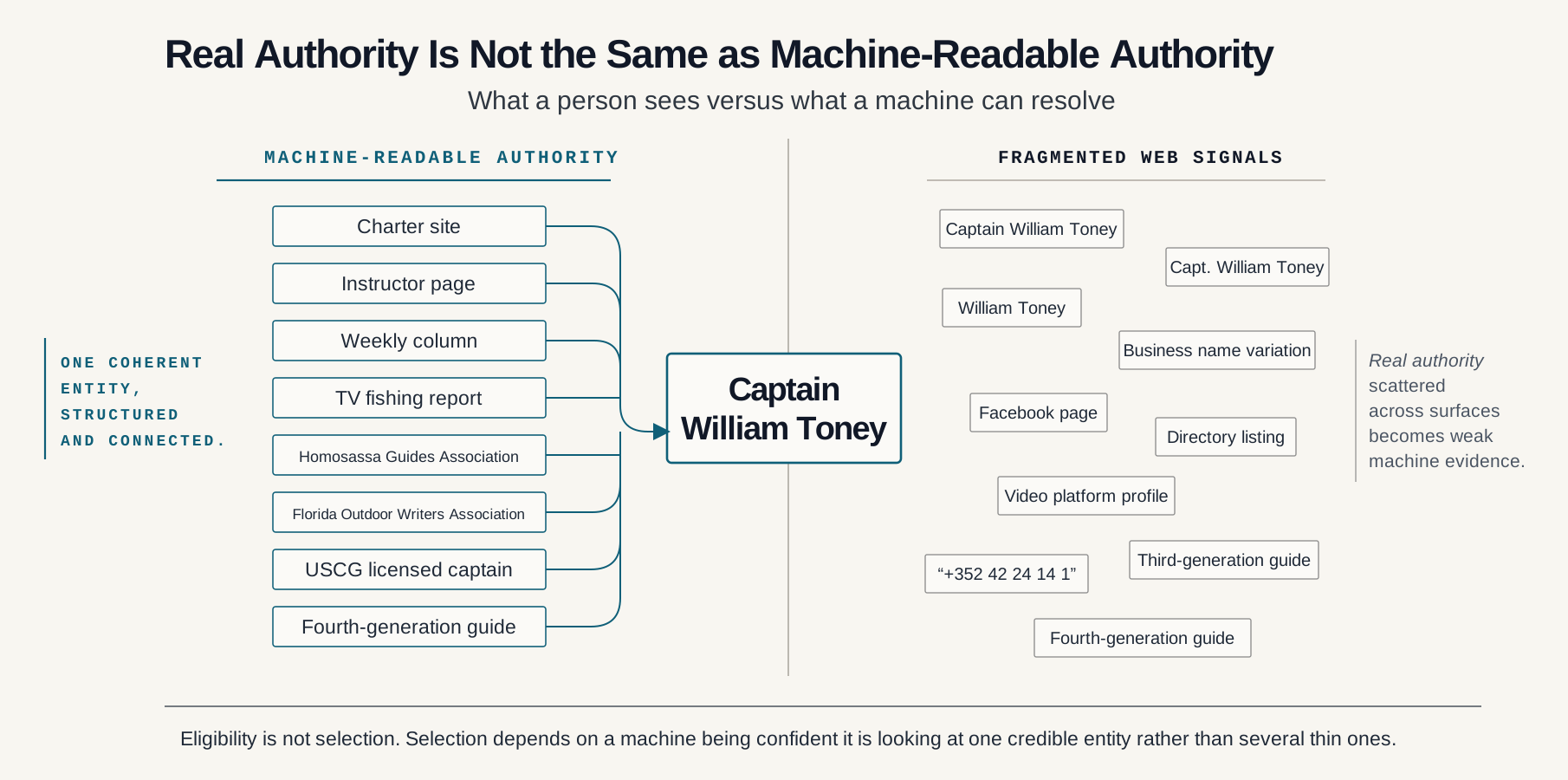
On one surface he is Captain William Toney. On another, Capt. William Toney. On a third, just William Toney, tied to a business name that does not obviously match the others. His own charter site marks his phone number correctly, as a Citrus County number. His Facebook page renders the same number as +352 42 24 14 1, reading the local 352 area code as an international dialing prefix, and files the page under Interest rather than under any kind of business. A directory lists him one way. The video platform lists him another. None of these are wrong on their own. They are just unlinked, and unlinked is the failure.
To a model deciding who to cite when someone asks who to fish with in Homosassa, that is not one authoritative operator with a deep record. It is a handful of weak, half-overlapping fragments. Fragments lose to a competitor with half the credentials and one coherent identity.
Eligibility is not selection
This is the distinction that clears up most of the confusion. There are two separate questions, and they have two separate answers.
The first is whether a machine can reach the content at all. Call it eligibility. Toney is eligible everywhere. He appears in directories, on the video platform, on his own site, on social profiles, in a weekly column. Nothing is blocking access.
The second is whether the machine chooses to cite him when it matters. Call it selection. Here he loses, because selection depends on the machine being confident it is looking at one credible entity rather than several thin ones. Eligibility is a door being open. Selection is being the answer once inside. He was walking through every door and getting picked in none of them, and no amount of additional content fixes that, because the failure is not missing information. It is unresolved identity.
The single-fact test
Take the simplest fact he has: which generation of guide he is. The answer is fourth. I confirmed it with him directly.
Earlier this year, one of the outlets that publishes his column carried two different answers in its own author bios, third generation on some posts and fourth on others, applied inconsistently across years of archived pages. This is not negligence, and I am deliberately not naming the outlet, because the outlet is not the villain. A stale bio template sitting next to a newer one is among the most common artifacts on the web. It exists on an enormous number of sites. Correcting this one took a direct email and an editor who fixed it within a day.
That is the good case. That is the manual path working as well as it ever works: a responsive human, reachable, willing, fast. Now count the surfaces where there is no editor to email. The social profile parsing his phone number as an international call. The directories. The cached copies. The aggregators that scraped him years ago and will keep serving what they scraped. You cannot email any of those. The manual path is slow, it is gated on someone answering, and it is incomplete by nature. You will never finish correcting the open web, because the open web is not yours to correct.
The fix is one node, not a thousand corrections
If you cannot correct every source, you publish one source authoritative enough that a machine resolves the conflict in your favor.
That means a single canonical entity for the person, on the property you actually control, declaring one name, one generation count, one set of credentials, and naming which other surfaces around the web are the same individual. Not prose that a human reads and a machine skims. A structured declaration, in the format machines actually parse, that says this person, here, is the same person as that profile, over there.
Toney’s charter site now does this. It carries a canonical entity for him and declares, in structured data, that the guide running the charter business is the same guide teaching on the video platform. It does not erase the fragments elsewhere. It outweighs them. A model that encounters a stray third-generation reference on one page and a self-consistent, first-party, structured node on another has a clear basis for choosing the second. Without that node, it is just counting mentions, and mentions are exactly what fragmentation inflates.
The job was never to manufacture authority
Toney has four generations of authority. Nobody needs to invent it, inflate it, or spin it. The entire job is translation: making authority that already exists legible to systems that read in a format people do not write in.
That reframes what this kind of work is. It is not marketing in the sense of making someone look bigger than they are. It is closer to engineering. You take a real thing that is currently unreadable to the machines deciding who gets cited, and you make it readable, without adding a single claim that was not already true.
Which leaves the question this is really testing. His instructor page, on a platform I run, is what complete looks like when one operator controls everything. His charter site is the harder case, a property standing on its own. The open web around both of them is full of fragments that neither he nor I can reach. Can one engineered node outweigh all of that? That is the experiment. I will report what the data says once there is enough of it to mean something.
Related reading
The mechanics underneath this piece are covered in AEO vs GEO: What’s the Difference and Why It Matters, which explains how AI systems extract and cite content, and The Fishing Industry Has a Visibility Problem, which puts the same entity-resolution failure in the context of an entire industry.