
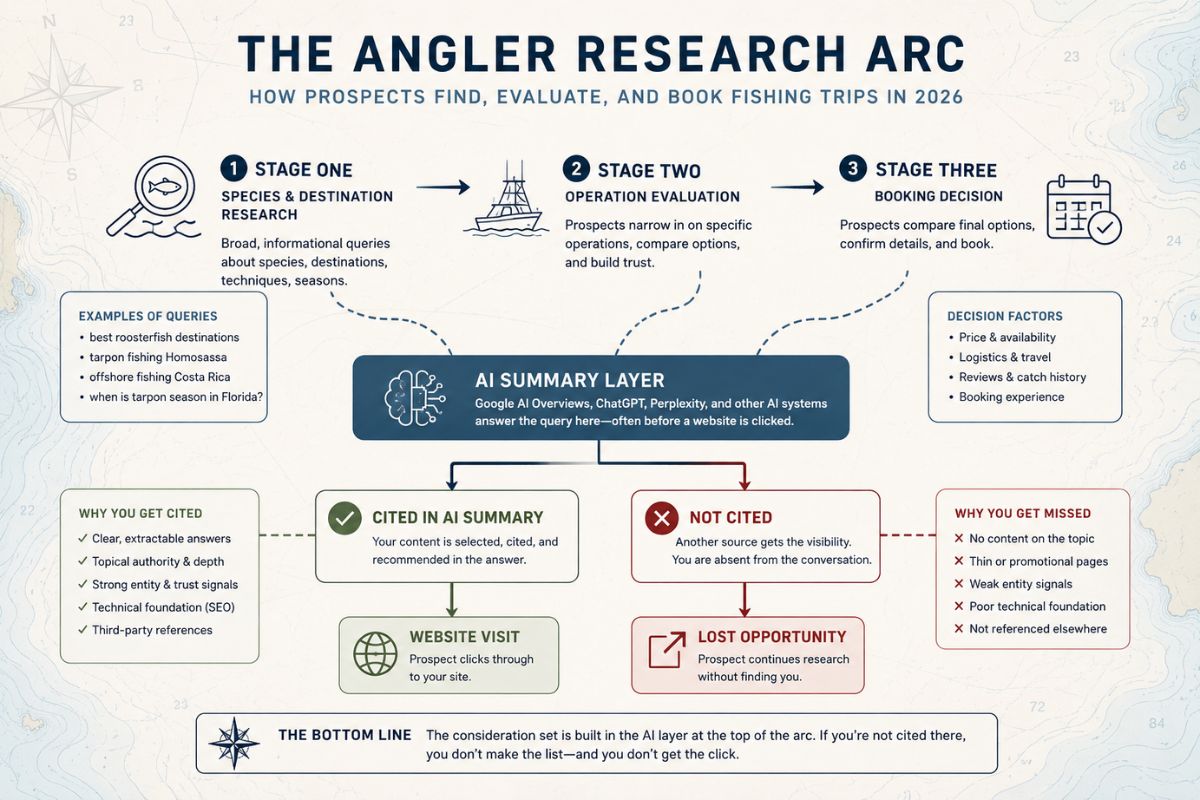
Anglers do not book fishing trips the way they buy consumer goods. The research arc is longer, more species- and destination-specific, and increasingly routed through AI-generated answers before a prospect ever reaches a charter website. Most fishing businesses are not structured for any stage of that arc. Understanding how the research actually unfolds is the starting point for building a site that can intercept it.
The arc starts before anyone opens a search engine
For a meaningful share of charter bookings, the research arc has an upstream phase that precedes any search query. A captain who places in a tournament, contributes to a fishing publication, teaches on a platform like In The Spread, or is consistently referenced in regional fishing circles enters the search phase already carrying name recognition. When a fellow angler says “book Capt. Toney if you want tarpon in Homosassa,” the prospect’s first query is not “tarpon fishing Homosassa.” It is the captain’s name directly.
This matters for site architecture because it changes the entity definition problem. A captain with documented industry standing, named publication credits, association memberships, and third-party references is not starting from zero when AI systems assess whether to cite him. Those signals are already in the open web. The visibility work is a matter of organizing and reinforcing what exists. A captain without that standing faces a harder version of the same problem: the entity work has to be built from the site outward, not confirmed by it.
Stage one: species and destination research
For prospects who do not arrive with a name already in hand, the arc starts broad. They know they want to catch roosterfish, or fish Costa Rica, or target tarpon in Florida. They are not yet searching for captains or lodges by name. They are querying the fishery itself: “best roosterfish destinations,” “tarpon fishing Homosassa,” “offshore fishing species Costa Rica.”
These are informational queries, and in 2026 the majority of them resolve inside a Google AI Overview, a ChatGPT response, or a Perplexity summary before the prospect clicks anything. That is not a projection. Seer Interactive’s September 2025 analysis of 3,119 queries across 42 organizations found that organic CTR drops 61% when an AI Overview is present. In Google’s AI Mode specifically, 93% of searches end without a click to any external website. Sixty percent of all Google searches now end without a click overall.
A site with no content on the species, the destination, or the techniques relevant to its fishery does not exist at this stage. The prospect is being educated by whoever did show up in the AI summary, and the consideration set is forming around sources that are not the operation.
The sites AI systems cite at stage one are not chosen randomly. They pull from sources with clear, extractable answers organized around the questions being asked. A page that opens with a direct answer to “when is roosterfish season in Costa Rica” and organizes supporting content around related questions is citable. A page that buries the same information inside promotional copy about the lodge is not.
Stage two: operation evaluation
Once a prospect has enough context to know what they are looking for, the queries get specific. “Roosterfish lodge southern Costa Rica.” “Homosassa inshore guide.” “Tarpon fishing captain Crystal River.” This is where named operations surface in search results, in AI-generated comparisons, and in forum threads, fishing media, and YouTube channels covering the destination.
Video is a significant trust channel here. A prospective client researching an offshore Costa Rica lodge or a Louisiana bluewater operation is likely to watch footage of the fishery, the boat, and the captain before forming a booking intent. A captain with on-water video content discoverable in YouTube search carries trust signals into the evaluation phase that a captain without video cannot replicate.
The trust signals a prospect is looking for across stage two are concrete: named captains with documented experience, species-specific content that demonstrates genuine knowledge, real imagery and video from on-water trips, and the operation’s presence in third-party sources. A site that is nothing but a trip menu and a booking button reads as thin here. The prospect is trying to determine whether the captain knows what he is doing. Content that demonstrates that knowledge is the only thing that actually answers the question.
Entity definition matters structurally at this stage. Schema markup at the Organization and LocalBusiness level, a well-defined Person entity for the captain, and consistent signals across the site and the open web determine whether AI systems surface the operation as a recognized authority or as generic text. A captain with writing credits, seminar appearances, media features, and association memberships should have all of that represented in the site’s structured data and content, because those signals are what AI systems use when deciding whether a business is a reliable reference on its specific fishery.
Two notes on parallel discovery systems: aggregator platforms like FishingBooker operate as independent discovery ecosystems that some anglers use as a primary interface, bypassing the traditional search arc entirely. And the overlap between Google’s top-10 search rankings and what actually gets cited in AI Overviews has collapsed from 75% in mid-2025 to between 17% and 38% by early 2026, according to research published by Mersel AI. Ranking is no longer a reliable proxy for AI visibility. They are different problems.
Stage three: booking decision
This is where the prospect is comparing one or two specific operations and deciding. Price, availability, logistics, and the booking flow all factor in, but the decision is still being shaped by operational credibility: named client reviews, documented catch history with species and locations, partner relationships inside the regional fishing ecosystem.
The booking flow itself is a conversion problem most charter sites handle badly. A prospect who has to email to ask about the deposit structure, cannot find clear pricing for multi-day packages, or runs into a generic booking plugin that does not handle international transactions cleanly will not always follow up. Friction at stage three costs bookings that the entire research arc already produced.
What the arc means for site architecture
Each stage maps to a specific requirement.
Stage one requires topic authority on the fishery: a hub-and-spoke architecture organized around the species, techniques, seasons, and destinations that define the operation, with each topic having its own landing page and supporting content that reinforces it. A roosterfish lodge in southern Costa Rica needs a roosterfish page, a southern Costa Rica fishing page, technique and seasonal content, and internal linking that signals to search engines and AI systems which pages carry authority and which reinforce them. Each of those pages should open with a direct, extractable answer.
Stage two requires entity definition and trust infrastructure: schema that accurately represents the operation and the people behind it, consistent entity signals across the site and the open web, and content that demonstrates species-specific knowledge rather than describing it.
Stage three requires operational transparency and a booking flow that matches how the business actually operates. International deposits, seasonal packaging, multi-species itineraries, and trip customization are common in this industry. Generic booking plugins do not handle them cleanly, and the friction costs bookings.
The gap most fishing sites share
Most fishing charter websites are built for stage three and nothing else: a trip menu, a booking button, and a contact form. They produce no content at stage one. They define no entities and build no trust infrastructure at stage two. And often they do not even handle stage three cleanly.
The consequence is invisibility at every stage where the consideration set is being built, and lost bookings at the one stage where the site is present. That is not a design problem. It is an architecture problem, and it requires infrastructure work to fix.
The cited-vs-uncited divide is the frame worth holding onto here. Semrush’s 2025 AI Overviews study found that brands cited inside AI Overviews get 35% higher organic CTR than non-cited competitors on the same queries. The loss from zero-click is real. The gain from being cited inside the AI summary is also real. Those are not offsetting forces. They are a split that widens over time in favor of whoever built the infrastructure to appear in the answer layer first.
For the mechanics of how AI systems extract and cite content differently at each stage of the arc, see AEO vs GEO: What’s the Difference and Why It Matters. For how that framework applies specifically to fishing industry engagements, see the Sport Fishing vertical page.