
Anyone can generate a website audit now. Point a model at a URL, ask what is wrong, and it returns a list. The list is always long, always confident, and always framed as urgent. That is not a sign the site is broken. It is a sign the tool did the one thing it is built to do, which is produce findings.
So the useful skill has moved. It is no longer generating findings. It is reading them. When an audit lands in front of you, whether a vendor sent it or you ran it yourself, you need a fast way to separate the findings that matter from the ones that only look like they do.
Here is the concession that has to come first, because plenty of people are getting this wrong in the other direction. AI search visibility is real. Getting named and cited by answer engines is worth the work, and the sites that earn it will pull ahead of the ones that do not. Foundational SEO still decides outcomes, the same way it did before any of this arrived. None of that is in question. The problem is not the work. The problem is the flood of manufactured urgency built on top of it, and the defense against it is a test you can apply in about a minute.
Three questions. Run every finding through them in order. A finding that cannot clear all three does not belong at the top of anyone’s list.
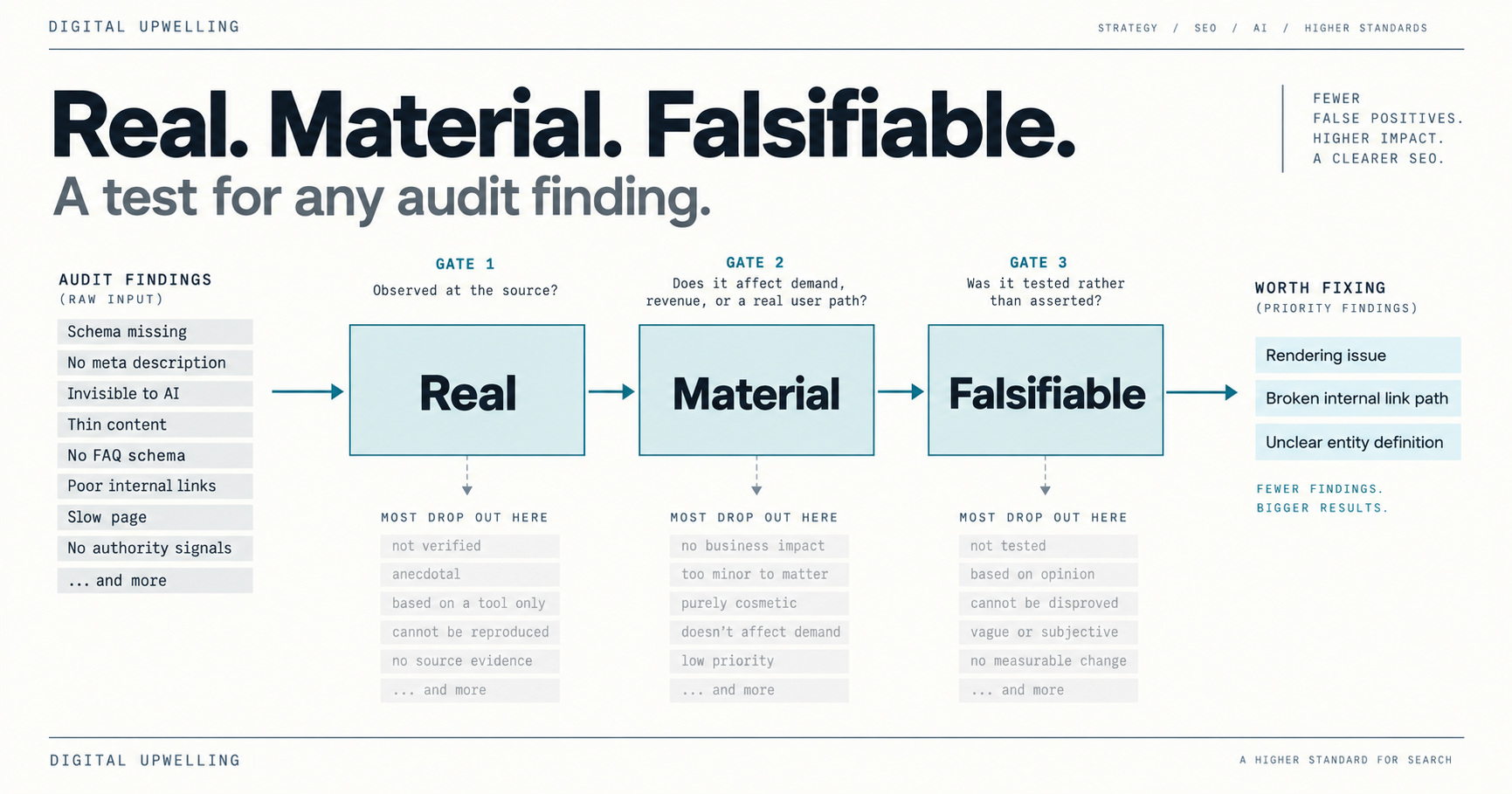
Is it real?
A real finding was observed at the source. A manufactured one was inferred from something that could not carry the evidence, then stated as fact.
The most common example is schema. An audit fetches a page, sees no structured data in what it pulled back, and reports that the site has no schema. That finding is not real, because a standard page fetch does not reliably expose JSON-LD in the first place. The markup can be present and simply invisible to the method used to look for it. The audit did not find an absence. It failed to look correctly and called the failure a defect.
The tell: the finding rests on a tool’s default output with no confirmation step. No view-source. No structured-data test. No second method.
The check: ask how it was confirmed. A real finding names the observation behind it and survives a look at the source. If the only support is that the tool said so, it is a lead, not a finding.
Is it material?
A material finding touches something that matters commercially. An immaterial one is housekeeping dressed as a crisis.
A missing meta description is the classic. It is easy to detect, easy to list, and easy to inflate into a claim about lost visibility. Usually it changes nothing a buyer or a search engine acts on. The same goes for advice built on formats that no longer do anything. Recommending FAQ schema for rich results is a current example, since Google stopped showing FAQ rich results for most sites. The recommendation sounds modern and is already dead.
The tell: the finding is technically true and connects to nothing. It names a defect but not a consequence. It cannot say which product, page, buyer, or decision is affected, because the honest answer is none of them.
The check: ask what breaks if you ignore it. A material finding has an answer that involves demand, revenue, or a real user path. An immaterial one only has that it is not best practice.
Is it falsifiable?
A falsifiable finding could be proven wrong by a test, and someone ran the test. An unfalsifiable one is an assertion dressed as a diagnosis.
The site is invisible to AI is the headline version. It sounds like a measurement. It is almost never backed by one. If nobody ran the actual queries through the actual systems and recorded what came back, the claim cannot be checked, which means it cannot be trusted. The honest version of that finding looks completely different. It states which prompts were run, on which systems, on which date, and what each one returned.
The tell: a sweeping claim about how machines see the site, with no prompts, no systems, no dates, and no outputs. Confidence with no record behind it.
The check: ask to see the test. A real visibility finding comes with the queries and the results attached. If there is nothing to look at, there is nothing to the finding.
What a real finding looks like
Put the three together and the standard is simple. A finding worth acting on was observed at the source, touches something that matters, and was tested rather than asserted. It survives all three questions without special pleading. Most of what a generated audit produces will fail at least one, and the ones that fail are not a small share of the list. They are the bulk of it.
This is not an argument against audits, and it is not an argument against AI visibility work. It is an argument for holding both to a standard. The tools made it trivial to produce findings and just as trivial to produce bad ones. The fundamentals did not change. A good website is still built on real structure, real content, and real evidence. The way you tell whether a problem is real did not change either. You look at the source, you ask what it costs, and you check whether anyone tested it.
The next time an audit shows up with forty urgent problems, run the test before you run the panic. Real, material, falsifiable. Most of the list will not survive it, and the few findings that do are the only ones worth paying to fix.