
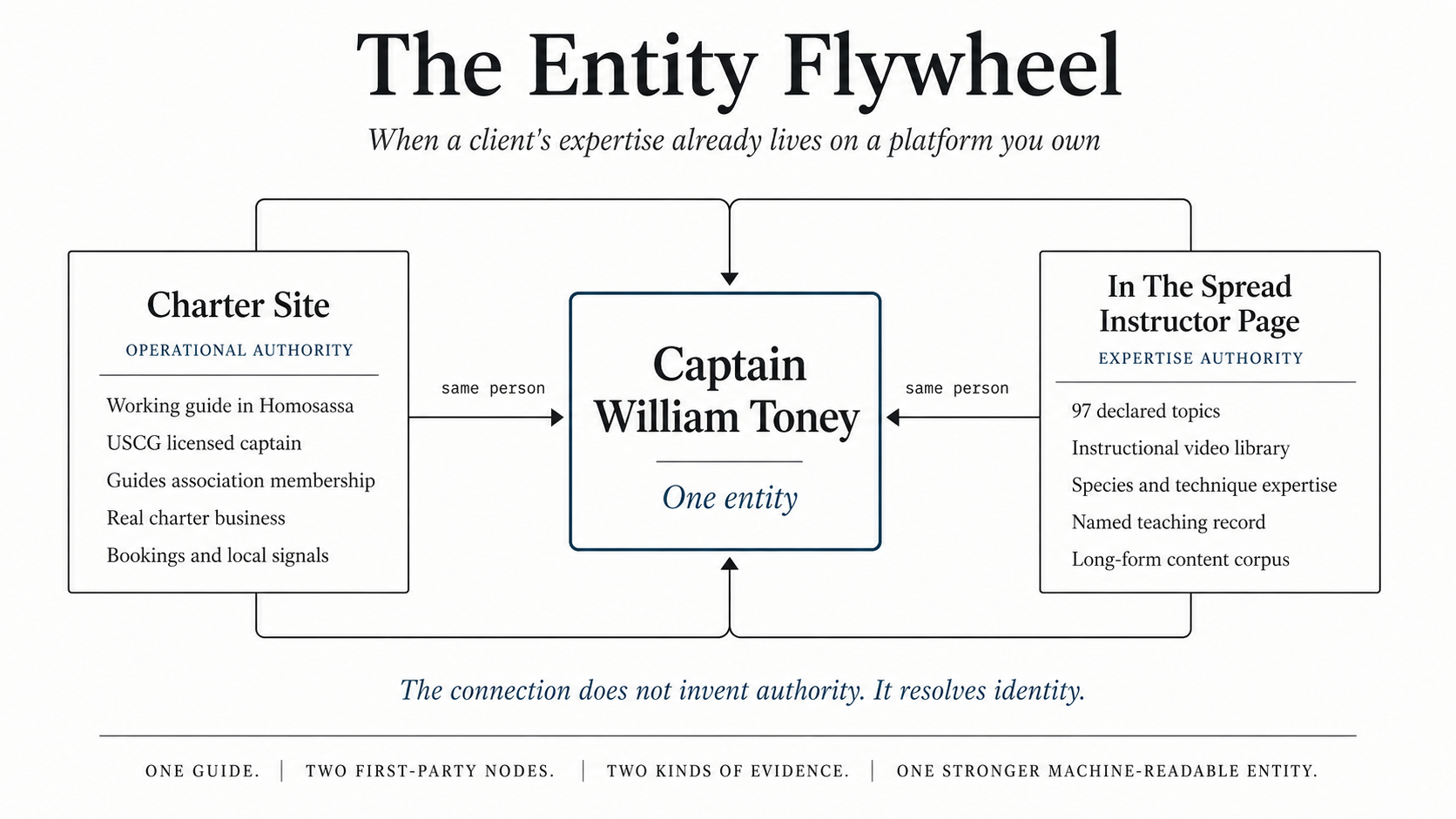
Captain William Toney exists on two websites that matter for this argument. One is homosassainshorefishing.com, the charter business my agency built. The other is his instructor page on In The Spread, where his teaching record lives. As of now, each site declares in its structured data that the person on the other is the same person. Not a link a reader clicks. A machine-readable assertion, on both ends, that these two entities are one man.
That mutual declaration is the whole point of this post, and it is worth understanding why it makes both sites stronger than either could be alone, and why almost no agency in this field can reproduce it.
The disclosure is the subject this time
The last two posts carried a disclosure. This one is built on it, so I will put it as plainly as it goes. I own In The Spread. Captain Toney is a minority owner of it. My agency built his charter site. All three of those are true at once, and if that arrangement makes you narrow your eyes, good, because the honest version of this argument has to survive that scrutiny.
So here is the honest version. I am not describing a trick for inflating a client. I am describing what happens when one person’s real authority is spread across two properties I can see into completely, and what it takes to make a machine understand they belong to the same person. The authority on both ends was earned before I touched either site. My work connects it. It does not invent it, and the distinction between those two things is the entire post.
Two nodes, two kinds of evidence
The reason the pairing works is that the two sites carry different proof about the same man.
The charter site anchors the operating business. It says he runs a real charter service out of Homosassa, that he holds a Coast Guard license, that he belongs to the guides association, that he fishes specific water on a specific boat and takes real bookings. That is operational authority, the evidence that he is a working professional in a place.
The In The Spread node anchors the expertise. It declares, in the machine-readable way the last post described, the full footprint of what he teaches, ninety-seven topics derived from his actual instructional library, each one resolving to a real page. That is a depth of declared expertise a charter site alone would never carry, because a charter site is built to book trips, not to enumerate a body of knowledge.
Separately, each is a decent but partial entity. One knows he operates. The other knows he teaches. Neither knows both. The moment the two nodes declare each other, a machine assembling an answer has one entity backed by two independent first-party sources that agree on the identity and contribute different evidence to it. A working guide who is also a documented teacher is a stronger, more citable entity than either half. The link does not add a claim. It lets the machine combine claims it already had but could not connect.
Why this is not circular
There is a version of two sites pointing at each other that is worthless, and it is worth naming so you can see this is not that. If you spin up thin profiles with no substance and cross-link them to manufacture the appearance of authority, that is a link scheme, and it collapses the moment anything real is examined.
The test that separates the two is simple. Remove the mutual declaration and ask what is left. Here, what is left is a real charter business with decades of operating history and a real instructional library with a hundred hours of a man teaching what he knows. Both bodies of authority stand on their own with the link gone. The connection did not create them. It resolved an identity question a machine could not otherwise answer. That is the difference between manufacturing authority and making existing authority legible, and it is the line everything I do sits on the correct side of.
How the loop compounds
Now the part that makes it a flywheel rather than a single wiring job.
Every new video Toney films adds to his declared expertise footprint, which strengthens his instructor entity, which, because the charter site declares that entity as himself, flows back as corroboration to the property that actually books charters. In the other direction, as the charter business accrues its own real-world signals over time, reviews, local citations, the weekly column, the television spot, those corroborate the In The Spread instructor as a working professional rather than a studio face. Each side feeds the other, and neither side runs on manufactured activity. It runs on him filming videos and running charters, which he does regardless.
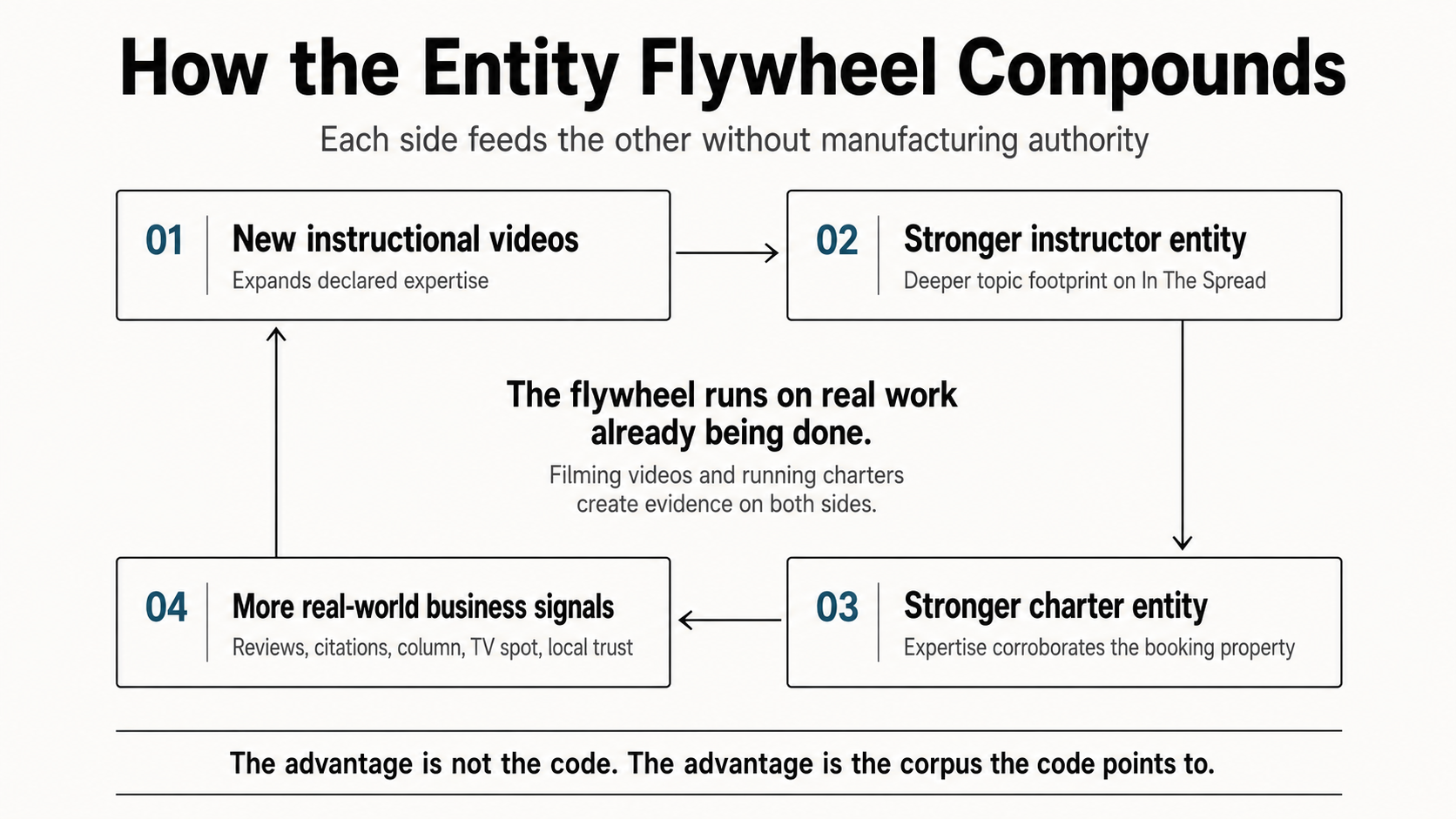
I want to be precise about what I am and am not claiming here. This describes how the loop is designed to compound. Whether it produces measurable lift in rankings or AI citations is an empirical question, and the honest answer today is that the data is still maturing. I will publish that result when it means something, in a case study built on matched-window comparison rather than on the mechanism I am describing now. The design is sound. The proof is pending, and I will not pretend the second is the first.
The part a competitor cannot copy
Everything technical in this and the previous post is reproducible. Any competent developer can emit a sameAs assertion and a topic graph. If the method were the advantage, it would not be an advantage for long.
The method is not the advantage. The raw material is. When a generalist agency wants to strengthen a client’s entity by linking their site to their broader presence, they are usually linking to a thin social profile or a directory listing, surfaces that carry a name and little else. When I strengthen Toney’s entity, I am linking his charter site to a first-party platform that holds a hundred declared topics backed by an eleven-year instructional library of him actually teaching. That is not a profile. It is a corpus.
You cannot copy a corpus with a schema template. You build it over a decade with real experts making real content, or you do not have it. That is why this advantage is structural rather than clever, and why it is specific to the fishing vertical for me and not portable to an agency that owns no such platform. The flywheel is not the code. It is owning the thing the code points at.
Where this sits in the sequence
The first post showed the problem, that real authority and machine-readable authority are different things. The second showed the method, what it takes to build a canonical entity a machine can trust. This one shows the advantage the method quietly stands on in this field, which is that the client’s expertise already lives, in depth, on a platform I can wire directly into the work.
What none of the three has shown yet is the number. Whether all of this moves a client property that has to stand on its own is the question the case study answers, and that data is coming in now. Mechanism first. Result next.