
The last post ended on a claim I owe you the mechanics of. I said the fix for scattered identity is one canonical node, authoritative enough that a machine resolves the conflict in your favor. That is easy to assert and harder to show. So here is the work itself, layer by layer, on a real platform.
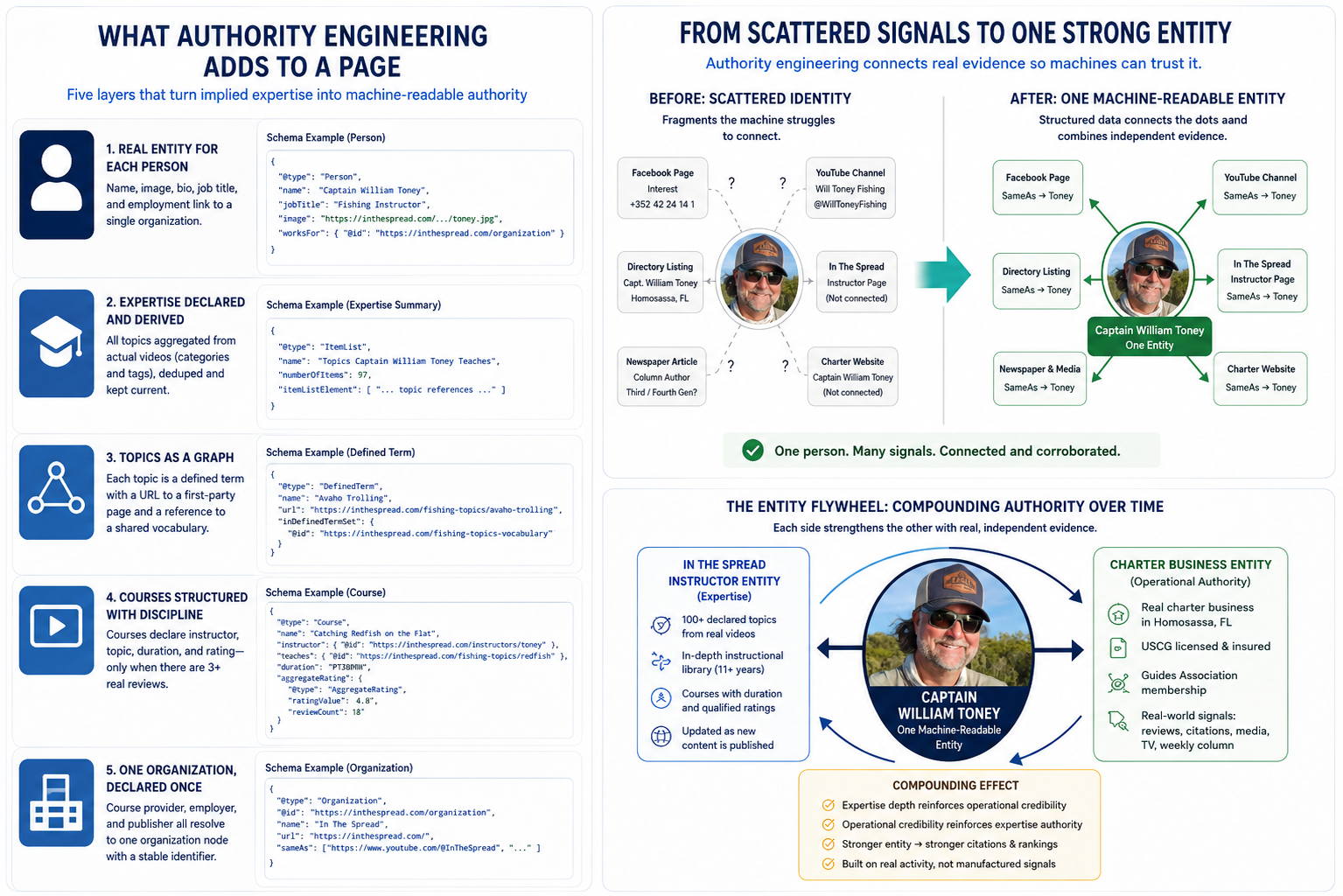
Start with a single thing a machine can now read. On In The Spread, Captain William Toney’s instructor page declares ninety-seven distinct topics he is qualified to teach. RJ Boyle’s declares a hundred and ten. Not as prose a reader infers from watching the videos. As a structured list, in the page’s machine-readable layer, stating each topic outright.
Disclosure, up front, because it changes how you should read the rest
I own In The Spread. This is not a client case study and I am not presenting it as one. It is the reference build, the version of the method I could take all the way precisely because I control every layer of the platform. The independent test, whether this transfers to a property I do not own and cannot touch end to end, is a client site. I will get to that evidence when the numbers are real. Read everything below as method, not as proof of result.
Implied is not declared
Before this work, a person could watch Toney’s library and conclude he knows snook fishing with artificial lures, shallow water reef fishing, winter trout on a falling tide. A machine could not, not with any confidence, because nowhere did the page state it in a form built to be parsed. The expertise was implied by the content and effectively invisible to the systems now deciding who gets cited. The entire job was to move it from implied to declared.
That happened in stages. Each stage is worth seeing, because each one is a decision most sites skip or get wrong.
Layer one: a real entity for each person
Every captain has their own page, and each page now carries a proper entity: name, image, biography, job title, and an employment link back to a single In The Spread organization node. Forty-three captains are featured on the instructors page, each a resolvable person rather than a name in a byline. This is the same move the previous post made for one guide, run across the roster.
Layer two: expertise, declared and derived
For each captain, we aggregated the full topic footprint from every video they have published, every category and every tag, deduped, with other captains’ names filtered out. That is where the ninety-seven and the hundred and ten come from. The list is derived from the actual teaching record, not hand-typed and not aspirational, which means it is accurate by construction and updates as the library grows. A captain who teaches a new technique on video declares that expertise automatically the next time the page builds.
Layer three: the part that turns a list into a graph
A list of topics as plain text is better than nothing and still nearly opaque. “Wahoo trolling” as a bare string is just a label a machine cannot follow anywhere.
So every topic was upgraded from a string to a defined term carrying three things: the term itself, a URL that resolves to the first-party page for that topic on In The Spread, and a reference to one shared vocabulary that every captain draws from. RJ Boyle’s page no longer declares “wahoo trolling” as loose text. It declares wahoo trolling, located at a specific live page, drawn from the In The Spread Fishing Topics vocabulary. Every one of those topic URLs resolves and returns cleanly.
That single change does three things at once. Each expertise term now dereferences to a first-party page, so the claim points at evidence instead of hanging in space. Each instructor page becomes a hub linking out to roughly a hundred topic pages, which is the shape an entity graph takes and the shape most commercial sites never build. And because every instructor page references one formal vocabulary, an answer engine can reason across the whole corpus rather than one page at a time. It can work out who else teaches what Boyle teaches, which captains cover daytime swordfishing, where two guides overlap on a technique. That cross-corpus reasoning is not possible when every page speaks its own private dialect.
Layer four: the courses themselves
Every video page carries course structured data: the instructor as a named person, what the course teaches, its duration pulled straight from the video record, and a rating, but only where at least three real reviews exist. Below that threshold, no rating is asserted at all.
That last choice is the discipline the whole project runs on, and it is worth stopping on.
The standard is what you refuse to declare
Structured data is a set of claims made to machines. The temptation is to declare whatever makes the page look strongest. We did the opposite at every turn.
The old implementation carried a hardcoded price of $22.95 on every course, inherited from a vendor template. It was not true, because access is a subscription rather than a per-course purchase. So we replaced it with the real model, then dropped the per-course price entirely, because stating a per-course price misrepresents how the thing is actually sold. Ratings appear only above three reviews, because one review is not a rating. The expertise list is built from real videos, because invented expertise is a lie a machine will repeat confidently and forever.
None of that is a growth tactic. It is the same standard I hold every client claim to. If it does not trace to something true and checkable, it does not go in, and that applies to what you declare to a machine exactly as much as to what you write for a person. Overstated structured data gets discounted the moment something contradicts it, and the open web contradicts everything eventually. The only durable position is to declare less than you could and have every word of it hold.
Layer five: one organization, declared once
The final layer is the person-level principle raised to the level of the whole site. Course provider, instructor employer, site publisher: before, these referenced the company in three slightly different places, three near-duplicate assertions of the same entity. Now they all resolve to one organization node with a stable identifier. The site also declares itself an educational organization sitewide rather than a generic business, because education is what it primarily does, and a machine should be told that plainly rather than left to guess. One entity, declared once, referenced everywhere it appears.
Why this is defensible and not merely thorough
The method here is repeatable. Any competent developer can emit these structures. What is not repeatable is the raw material. You cannot aggregate a topic footprint from videos that were never made, and you cannot build a shared expertise vocabulary across sixty captains you do not have. The schema is the easy half. The corpus underneath it is the half that took eleven years to accumulate. That is why this is a structural advantage rather than a checklist, and it is why a generalist agency cannot reproduce it by copying the markup.
What this proves and what it does not
That is authority engineering, shown instead of asserted. Every claim above is live and checkable in the page source today. What none of it proves yet is the result. This is a platform I own, built out as the reference version of the method, which is exactly why I could take it this far.
Whether the same method lifts a property that has to stand on its own, without my hands on every layer, is the question a client site answers, not this one. That data is still coming in, and I will show it when it means something rather than before. Method first. Proof next.